Updates from Ethiopia: Days 10-15

Day 10:
5 hours in the bus for a transfer to Jinka. We unload the bikes on top of a cliff and lunch on a fresh mayo sandwich, can't blame french cuisine!
Heavy rain sets in and we need to shorten trip as the dirt roads become impassable for bikes. We set off later for a 50km sprint to the Mursi tribe.
The Mursi is a tribe where the women have huge plates in their lips and ears. The grandfather takes out 3 teeth in the lower jaw and the grandma cuts the lip. Then they expand over time. One theory says that they started this to escape slavery and capture as they would be deemed too ugly.
They are hunters and kill any animals they can, giraffe, buffalo, elephant. They eat the meat and use the skin for clothes. The government is forcing them into agriculture now, and some take it up, but they live off blood, milk and meat.
For a girl the father has to pay 30-40 cattle and a Kalaschnikow. These are big guys and it the atmosphere can get aggressive. Last time Pele went there it escalated quickly and they got spears and guns out to renegotiate price, you can see they don"t mess about.
They killed a cow upon our arrival, head on the fire, guts all over place! Eating (men only) takes place in a circle on the ground covered with branches. The meat is consumed mostly raw, and some gets tossed on the coal, no spices. The atmosphere is really tense. We are happy to have our guards with us, but you can tell they are also nervous. In the bushes there are 2 metre tall guys like shadows with their Dunga spear. Conflicts are settled via fights, which are often fatal. Tattoos show what they have killed.
Day 11:
We start off with a tough climb of 700m upward, past beautiful tukuls, the traditional huts made out of leaves. It is only since the last couple of years that they have started making square houses as well, due to the availability of metal roofs. In each tukul they have an open fire place and a box to put the chicken in overnight.
When we arrive at the at the pass, heavy rain sets in. We have a 10km downhill through a spectacular canyon. A gravel road, puddles of rain and dirt, cliffs to the left, clouds hanging low, and we keep on going through the thunderstorm. We arrive in a valley where there is no tourism and according to Pele many of them have not seen white people before. So the cheering and support goes crazy, groups of motorcycles are driving next to us just across the open field.

But our Giraffe group also gets the flipside of it, 2 people are hit by stones and an attempt with a machete. It reminds us that our guards are here for a reason. From now on we drive in 'turtle' formation through the villages and each time there is a guy with a machete I keep my distance, just in case.
After another couple of hours through a grassy landscape with high trees, we arrive at our night camp, a school. In no time the whole village is pushing into the school boundaries. Our guards break off some branches and whip the crowd back. At nightfall we hear the noise level going up in town and some worry that they might come for another look after enough home brew, but it all stays peaceful. With enough Whiskey we make sure we sleep well in a tent, we are three and it is tight!
One eye opener for me today is how hard it must be to control or enforce anything here. There is literally no army, police or government once you get out of major cities. We sometimes pass checkpoints but they drop their guard when our police arrives. It is the simple equation of who has more Kalashnikovs.
Most regions are left to the tribes and they don't care about official borders. Fights are about cattle and land, in areas are so remote there is no chance to have a law enforcement. Jurisdiction is based on tribal rules, mostly internally to regulate the tribe.
When tribes go up against each other it is hard to imagine there being accountability for killing or rape. Many would also not identify as Ethiopians, but Karo, Mursi or others. They hardly know the name of the next big city, as it is not part of their universe.
You wonder how you want to run a country as we define it. Taxes, laws, respect for a central government, I cannot see this happening. There is also simply no money for anything, which is also a mean to provide bonds. President Abey is now introducing more democracy, but the party lines go now all along the ethnic groups, which us a set up for more unrest. It is not as we know it a competition for a better idea or system, it is more who rules who and gets to power. Talking to local Ethopian business man, he said that Ethopia needs another 40 years to get developed, when the current generation is replaced with a fresh generation and ideas.
For dinner we get a local goat, well you can tell why people here have strong teeth! Only after dinner they show us the video of the butchering. They cut the throat and one guy after the other drinks the blood from the throat. Animals have a good life here. No mass breeding and they are part of the homes, but the last day in their live is not nice!
Day 12:
Overnight we have torrential rain on our tents and most spring a leak. We wake up to mud all over in the morning, everything is wet and dirty.
Pupils arrive at school and get whipped in by headmasters with branches. We take off through a different nature, wide and green, big trees spread around. After the rain the streets are all muddy and we have to cross dirt pool after dirt pool. A detour makes us climb for 25km in 40 degree heat. Lots of swearing and moral at an all time low. The downhill is 40km, but a dusty road with lots of trucks. Most go in the bus now, but the Cheetahs keep on going, each one battling his own crisis!
After 85km we reach lunch. As the others were here before us, we find out all the food is gone. Back to bananas and energy bars. As we arrive in the night lodge, we need to clean the tents and fix the bikes, do our laundry. We get to dinner at 9.30 which is cold by the time we get there. Well, not every day is a hay day.
Day 13:
More people come to support the tour towards Jimma, Mina Burri, André Lüthi from Globetrotter, Toman from J&J Schweiz, Hugo Herzog from the foundation and Alec von Grafenried, the mayor of Bern. Plus Sandro from Swiss Television who will make a broadcast for Glanz und Gloria.
Today is a moderate etap of 75 km, mostly on asphalt, the focus on the landscape and seeing Ethopia. We camp in the evening in a school, open fire and pasta with Tuna sauce. It is already dark and our head torches serve as lighting as Nina does a snake lady performance and Bettina Schelmer treats us to some songs from her latest album. Andreas offers 6 bottles of Bordeaux.
Speeches are made people are praised: Needless to say, Pele, to have made this all possible, Oliver for organizing and of course the indispensable Judy. The kitchen team, who treated us under most difficult circumstances. And Stephan Joliat with his bone tech support, without him, only have of us would have arrived!
You can tell that this is the last evening of the adventure before we go to the hospital. An unforgettable event comes to an end before we will see the purpose of all this riding: the hospital in Jimma! Tomorrow will be like the last day of our Tour de France, rolling into Jimma, the Paris of Gostar so to speak!
Day 14:
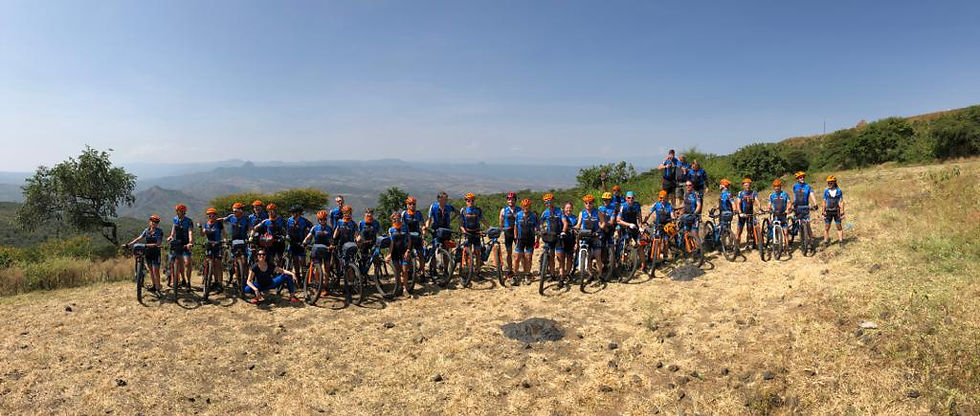
The last etape of our tour gets us from Soto to Jimma. It is more than 200 km and we need to do some of it in the bus. We set off in Soto and ride around 60km till we reach the edge of Omo river valley again. A breathtaking view and we stop for last group pictures. You can fell the melancholy setting in as our bike adventure is comeing to an end.
We stop for lunch in a local chicken raostery and get another test of our teeth strength. It is amazing how we are not used to chewing hard meat, no issues for the locals!
We then load up the bikes and drive towards Jimma. Before we get there we unload the bikes and ride the last hour together into the sunset towards our destination. Everyone pushes themselves to get on their bikes for the last stretch, we have about 5 people with diarrhea and colds. Others are too exhausted to even pedal up a slight hill, so we take them in the middle and push them. Judy gets on a bike and pedals in front, and the SRF camera team is there to capture the moment.
Then we arrive in Jimma, the city where our new surgery department is being built! We drive to the welcome lodge and everyone has tears in their eyes. This is the moment we all realize that a great inspirational idea has come to fruition.

The concept of raising money by biking through Ethiopia and getting access to regions and experiences money could never buy. 30 very different characters rallied under one purpose - improving trauma surgery in Africa.
As I sip my beer I reflect on all the different days. I was lucky to by spared diarrhea and other sickness. I'm pleased with my form on the bike, having stuck to my plan of starting slow and building up over the days. Together with Mika and Pele we were the leaders in our Cheetah group, providing the slipstream for our team.
As we drained our welcome beers we transferred to the Gostar guest house, a great building with about 8 bedrooms. The rest of us camp on the terrace and garden. The evening is full of energy and we compete in a singing contest with the Basler Lied with our Jurassic friends - and lose miserably. As I rest my head on the inflatable pillow in the tent, a great feeling of satisfaction overcomes me as I fall into sleep.
Day 15: Hospital day
Now we will see the purpose of our trip. At 7.30 we leave with Pele for a 10 minute walk to the hospital. He will perform surgery on a little girl who has some form of a rotten bone disease. He needs to open both arms and one leg and drill out the rotten parts and replace it with fresh muscle flesh for healing. I witness all the briefings with the Ethiopian doctors and the preparation, but leave the room ad they go to the surgery, too much for my stomach!
What was news to me is how laser-focused our Gostar project is: Pele and the Swiss doctors 'only' do the surgery. The emergency and patient rooms are run by the hospital and it is in appalling condition. People are lying on broken benches under staircases with all kind of metal in their bones. They mostly have no painkillers, this needs to be bought by the family in pharmacy, should it be open. Many are malnutritioned or are suffering from other diseases. They are unwashed for weeks and the smell is quite something. The good news is that in the new part of the hospital Gostar will also be able to run a bed station and 3 Operational rooms. This way they will be able to improve the current situation.
Though our engagement in the last 13 years Gostar has done more than 10,000 surgeries, trained 95 Ethiopian doctors as trauma surgeons and had 60 Swiss doctors stationed in Jimma.
The Swiss surgeons are an invaluable development measure. They see situations and can help people with surgery which costs only 10-30 Swiss Francs. They are the center for 14 million patients. Most patients arrive after days or weeks with open fractures and they have to make fast and hard decisions who gets surgery and who won't. . We all understand how hard it is to decide so directly on who will live and who won't.
Our engagement is fantastic because of its direct and narrow focus. Synthes/J&J is a paramount sponsor with its metal plates and screws and special conditions.
Gostar provides trauma surgery from top Swiss experts. They are paid by the hospital who sends them and Gostar reimburses the hospital for the 3 months the doctor is in Ethiopia. We are also building up a panel of grey panthers - retired surgeons who will come for 1-2 months, but don't need payment as they already have a pension. The focus is on training local doctors, which works well. It is important to understand that Gostar is being embedded in the Jimma Hospital operation, which belongs to the Jimma University. They provide infrastructure and Gostar trains their doctors - 95 in the past 13 years! This might not sound like a lot, but it is in an African context.
Here some sound bites how reality looks in a hospital:
The hospital was built by the Chinese, so all equipment is Chinese. When it was built, they found out that they didn;t have enough electricity. So it stood idle, because they had to built a damm first and a power plant. Maintenance is outsourced to the Chinese and the technical conditions are bad: most doors are unhinged, seats broken, beds rusty, staircases closed. There is a lot of good and high tech stiff installed, but you can tell that nobody supervises overall operations. There is lack of capabilities in many aspects. X-ray is still unwrapped in the basement, it takes much longer since lots if the basics we take here as a given. I am sure when we get to open it the instructions will be in Chinese!
Eventually it will all come together, it just takes lot longer as Pele needs to organize everything around it. In 6-12 months, Gostar will have 3 operation rooms with modern equipment and will run the bed station installing new hygiene procedures. This will be a milestone and be the leading trauma surgery center in east Africa!
This, thanks to our commitment and donations.
As I leave the hospital, reality hits again: An Isuzu pulls in with an emergency stretcher on the loading area. The new ambulances are here, but not allowed to drive, because the government waits for some taxes from the clinic. They unload the stretcher and an old man and his sons emerge from the clinic entrance crying loud and tearful as they get back into the Isuzu. Obviously it was too late for their relative. This shows how direct the impact is. But also how direct our help can maintain life and mobility for only 30 Swiss Francs.
Vielen Dank Pele
Et merci de nous donner access a une experience exceptionell!!!
Super Group. Da fliegen einem die Löcher aus dem Käse!!!!
Dir gute Besserung und take a break nach diesem Stress!
Michi


Comments